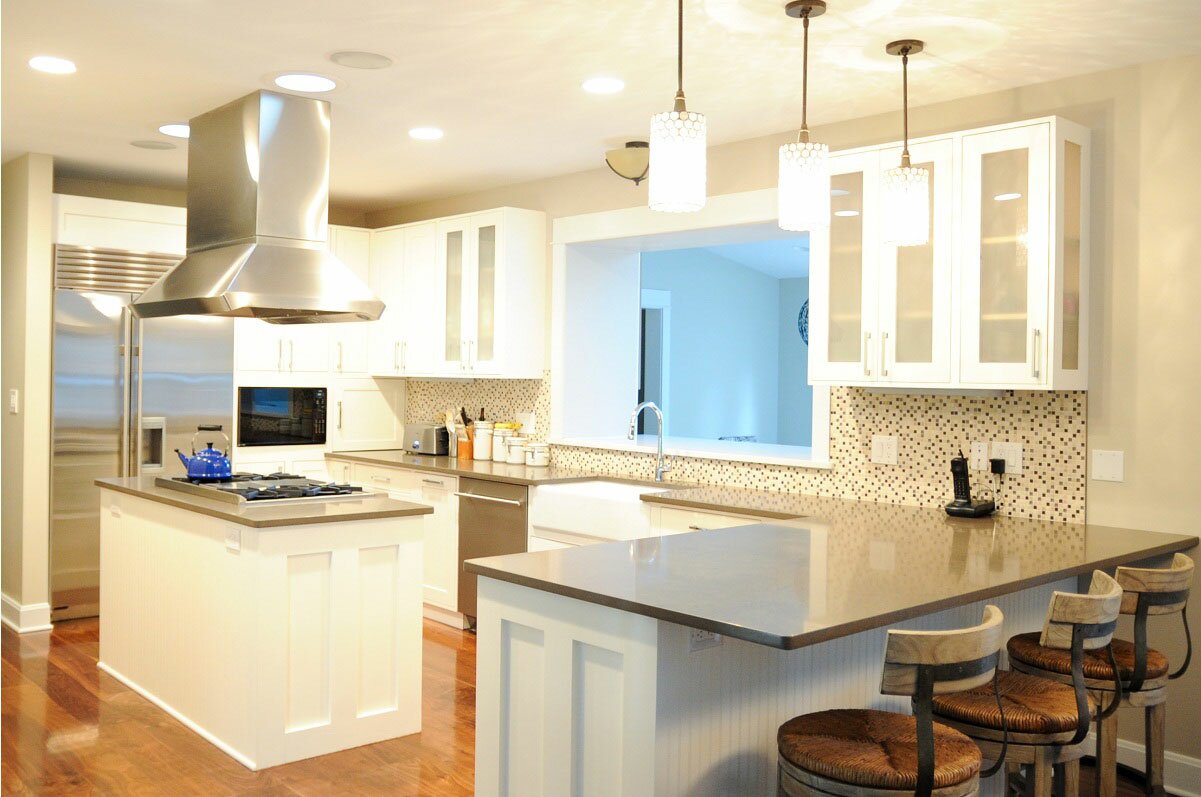

Kitchen Remodel Return on Investment (ROI)

It all starts with the kitchen
For many home buyers the kitchen is the first room to look at and increasingly the center of family life and entertaining. A dated, poorly designed kitchen can drastically effect your home value and saddle potential buyers with a 5 figure (or more!) remodeling project before they even move in the first sofa. Conversely, a modern and well-appointed kitchen can offer a competitive advantage in the housing market as well as turnkey property convenience for potential buyers. Kitchen remodels have consistently provided a return on investment (ROI) of 66% on national average and returns can be maximized even further by making smart decisions.
Set Realistic Goals & Buy Smart

You can also shop smart by focusing on the kitchen appliances and features that potential buyers are looking for. It can be easy to blow the budget on a few items when remodeling a kitchen. Make sure you are spending your remodeling dollars on popular features and amenities that maximize the value of your remodel and the appeal of your kitchen to potential buyers.
At Rethink Renovations we work with clients to determine the best kitchen remodel options for ROI. From cosmetic kitchen facelifts to a major kitchen remodel, we can help design the kitchen of your dreams, maximize your ROI and increase your home’s value. Rethink your next home Renovation!
What is Sustainable/Green Building, and What are the Benefits?

Repurposed Wood Salvaged From a Wyoming Snow Fence
Sustainable building, also known as green building or construction, is a growing trend in modern residential and commercial construction that focuses on waste reduction, energy efficiency, occupant health and occupant comfort. While often viewed as a costly building process with the primary goal of being environmentally friendly, sustainable building has much more to offer. Sustainable building benefits include lower energy and maintenance costs as well as higher occupant satisfaction and property value.
Benefits of Green Construction
Lower Operating Costs
According to a 2009 report by the U.S. General Services Administration*, green construction uses 26% less energy and has a 13% lower maintenance cost compared to traditional construction methods. Sustainable building also leads to a 27% higher occupant satisfaction rate while reducing carbon emissions by 33%. In addition to these savings, many energy efficient installations qualify for federal tax credits, including: HVAC systems, insulation, roofing, geothermal & solar energy systems.
Increased Property Value

Radiant Floor Heat Install
Sustainable building can also increase the market value of your home or property. McGraw-Hill Construction’s latest SmartMarket Report**, New and Remodeled Green Homes: Transforming the Residential Market at the National Association of Home Builders’ (NAHB) National Green Building Conference and Expo, states that green building is expected to grow from 17% of the residential home market in 2011 to 29%-38% by 2016. This growth is fueled by consumers looking to save money, increase the value of their property and gain a competitive edge in the real-estate market. Sustainable building is particularly appealing to rental property owners as lower maintenance and operating costs increase profit margins.
At Rethink Renovations, we are constantly looking for new and emerging sustainable building and supply methods. We have the experience and expertise to design and build your next home remodeling project using the latest and most cost-effective sustainable methods and products. From a bath remodel featuring non-toxic paint and repurposed barn wood, to a full geothermal system with wells beneath the driveway, we work with our clients to design and develop a sustainable remodel that saves money, increases property value and gives you piece of mind. Rethink your next home Renovation!

Rethink Renovations – 2012 Design Award for Green Construction
Also be sure to check out our latest green build, winner of the 2012 St. Louis AT HOME Architect and Designer Awards in the green construction of a home category.
References
* Assessing Green Building Performance – by the GSA Office of Applied Services
** Quality and Value Driving Growth in the Green Building Market, According to New SmartMarket Report – by the National Association of Home Builders (NAHB)
Remodel – Wine Retail Store Shawnee Bluff Winery in Lake of the Ozarks, MO

Wine Store After
Wine Store is complete!
We are very excited to showcase our recent commercial project for a Wine Retail Store for Shawnee Bluff Winery in Lake of the Ozarks, MO. This store was custom designed by the Rethink Renovations Team to create a showcase for the wine itself.
The Custom Lighted Wine Displays were hand made by our Team, Barrett Elwyn and Chris Bereswill, using Green Certified Cherry Plywood (Formaldehyde-Free) and LED rope lighting.
The custom bar was made using salvaged oak flooring from previous Rethink Renovations remodels.
The flooring is Green Certified Shaw Laminate in a Walnut Finish.
The 2 large drum pendants and 3 small bar pendants are from local St. Louis architectural lighting company, OCL. Track lighting also aids in the overall lighting design.
The Rethink Renovations Team removed the drop ceiling and created a sleek exposed black loft ceiling to add height and dimension to the space.
The lounge in the rear corner is accented with an electric wall mounted fireplace that gives off heat and has a nice crackle sound to aid in the ambiance.
Once the client stocks the space with product, we will update the pictures to show how the bottles are illuminated by the lighted wine cabinets.

Wine Store After

Wine Store After

Bar – Wine Store

Wine Store Before

Wine Store Before
Rethink Renovations is Featured in CBS Money Watch
CBS Money Watch, February 2013. The President of Rethink Renovations wrote an article titled St. Louis Green Remodeling Company Works to Revolutionize Trade Education and the Future of Green Construction that appeared this publication’s April issue.
View Article: http://markets.cbsnews.com/cbsnews/news/read/23541100/St._Louis_Green_Remodeling_Company_Works_to_Revolutionize_Trade_Education_and_the_Future_of_Green_Construction
Rethink Renovations on KTRS Radio – Growing Green St. Louis
On May 12, 2013, Gail Griswold-Elwyn, President of Rethink Renovations, Patrick Channey of Turner Carpentry (who works consistently with Rethink), and Leadership in Energy and Environmental Design Accredited Professional (LEED AP) Jennifer Loui, a lifetime educator and curriculum developer, joined Jean Ponzi—“Green Jean”—on her Sunday morning “Going Green in St. Louis” radio show that airs on KTRS 550 AM. The conversation encompasses the green building movement in St. Louis, how green professionals weathered the recession, where to buy locally-sourced materials in St. Louis, and the need for green education in our high schools, trade, and vocational schools. Listen to the program here.
Rethink Renovation’s President Featured in Interiors & Sources Website
Dispelling 5 Pervasive Green Myths
When it comes to sustainable design, there are still plenty of clients who don’t think it’s worth their time. Here are some suggestions for dispelling five commonly held green myths
By Gail Griswold-Elwyn
Although a variety of polls illustrate that environmental consciousness is at an all-time high among the public, there is still resistance to change. Driving this resistance is bad information—outdated and now-irrelevant that have become cultural truisms. Below are the five most pervasive myths about creating an eco-friendly business—and some suggestions in how to refute them in your discussions with commercial clients.
Myth #1: Green building, rehabbing, or redesigning is too expensive for our organization.
Not anymore. Five years ago, eco-friendly products and services were priced slightly higher than traditional products and services. However, as demand for these products grew in the commercial space, the pricing has lowered and is now competitive.
We have seen this happen with VOC-free paints, organic cleaning products, and natural, non-toxic options for cabinetry and storage units. In addition, government tax incentives for commercial green building or remodeling have significantly leveled the playing field for companies looking to take that step.
You must urge your clients to consider the life-cycle costs of a green investment. If the investment is greater up-front, what are they getting in return? Improved indoor air quality (which can augment good health and contribute to increased productivity)? Utility bill savings? Tax credits and deductions for your business? Increased revenue? A recent study conducted by IPSOS, a global market research company, reported that 79 percent of consumers would rather buy from companies doing their best to reduce their impact on the environment. Be your client’s advocate and educate them to be their own.
Myth #2: Going green as a company is so overwhelming; you have to commit so much time and energy to it.
Many executives think that going green is an all-or-nothing proposition—that not only do you have to recycle, but you also have to remodel, compost your waste and install timed lighting in every cubicle to make a difference. The intensity of the green movement has, in some way, contributed to this anxiety about green. So have the high-profile examples of energy renovations being publicized (the Empire State Building, to name one).
The truth is, going green is a process and can only be done little by little. Emphasize a staged approach with your clients. Suggest small changes as part of clients’ new green initiatives, like shutting down their computers when they leave for the night. In addition, advocate Energy Star-labeled, higher-efficiency office staples when designing for a green-minded client. Show them how LED task lighting can provide the same power with less energy. Include non-toxic finishes and paints in your designs and samples. Little by little, green choices will become automatic for your clients—and you can facilitate their realization that corporate green commitments can be easy to implement.
SEE: Check out some of the sustainable surfaces and materials that will be on display at the I&S Materials Pavilion at NeoCon.
Myth #3: Corporate green initiatives are hard to maintain.
People seem to think that green technologies and products are inherently more difficult (read: frustrating) to operate/use. They hesitate on committing to high-efficiency or geothermal systems because of unfamiliarity. And while it is true that a learning curve does exist, green technology installers have also been trained to educate users about the day-to-day operation and simple maintenance of the technology. Emphasize this to your clients when your designs include some type of green foundational elements.
You can also remind clients that green products for the corporate space are often very passive from the user’s perspective. For example, “smart” power strips offer an easier way to eliminate devices’ power draws when not in use. In addition, many cloud computing and virtualization models incorporate shared infrastructure and benefits of scale, reducing hardware needs. This means energy savings, but also decreases in the carbon emissions used to power and cool these complex devices.
Low-flow faucets and plumbing fixtures that sense and report on water usage are also fairly easy to specify and install. There are many smartphone apps that allow you to control specific devices and switches remotely to control electricity usage. Passive green suggestions to your commercial clients can help them warm to your more broad-based green design recommendations. Plus, you can emphasize the fact that a healthier work environment leads to increased productivity—which will positively impact your client’s bottom line.
Myth #4: It doesn’t matter one way or the other if I adopt green practices in my business.
Your clients have bought into the fact that our environmental problem is so complex and dire that their efforts will not make an ounce of difference—and they are unfortunately not alone. According to a survey conducted by The Nature Conservancy, 29 percent of Americans believe that adopting greener lifestyles won’t make a difference on the environment.
This is incorrect; every effort makes a difference, especially since more than 40 percent of all the energy created in this country goes to the creation and running of man-made structures. It is imperative that you be informed not only about the cost-effective and established green design and building options (from passive options like VOC-free paint and low-flow plumbing fixtures, to more dramatic improvements like foundations constructed from insulated concrete forms), but also about corporate policy changes that clients can make on a smaller scale to help the environment.
Myth #5: Eco-friendly design doesn’t fit with our organization’s brand.
Green construction and remodeling is for everyone’s brand. In fact, it has been around since settlers chose to orient their homes toward the sun to maximize light and heat exposure. Green building is about the efficient use of time, money, materials and resources. It is a way to make spaces more functional. Experienced commercial architects and designers will respect the character of the business and its neighborhood and, in most cases, clients will not be able to tell a green office space from a traditional one.
What’s more, though, is that a green redesign often bolsters an organization’s brand. This is not a hard sell; people want to do business with companies that are striving to do the right thing. Green certifications and well-marketed efforts often provide a significant competitive advantage (especially if your client competes for government-sector work). In addition, the green design of a space can improve office conditions; your clients’ consumers will want to spend more time in places in which they can breathe easy and feel energized.
READ: How to reduce off-gassing for better indoor air quality.
According to The Nature Conservancy’s same survey, only 42 percent of American adults are familiar with the term “environmental sustainability” and even fewer than that believe it is possible to live that way. Although reports suggest that more than 90 percent of Americans are recycling, there are still some deep-rooted prejudices and misconceptions about what it really means to go green or adopt green practices—especially on a corporate-wide scale.
Know that your clients are intimidated by the propaganda, by the feeling that one change will not be enough to matter. They are scared, under-informed and, as a result, readily believe what is reported. In addition to bringing your professional expertise to clients, this new era of “green fear” calls for you to also become an educator of your clients.
Commercial clients are hungry for facts, and it is time to make going green in the commercial arena an accessible alternative by providing accurate information and highlighting the cost-effectiveness and ease of implementation.
Gail Griswold-Elwyn is president of Rethink Renovations, a firm founded in 2007 to offer green construction, design/build, and full lines of cabinetry and furniture that minimize environmental impact. For more, please visit the company’s website or call (223) 226-1828.
Article Source: http://www.interiorsandsources.com/article-details/articleid/15731/title/dispelling%205%20pervasive%20green%20myths/page/2.aspx
Rethink Renovation’s President is Featured in Yoga and Spa Magazine
Rethink Renovation is featured in Yoga and Spa Magazine, page 40.
View Article: http://www.yogaandspamagazine.com/Files/Spring2013_web.pdf
Rethink Renovation’s President wrote an article National Awakenings Magazine
Banish these Five Chemicals for a Domestic Detox
GAIL GRISWOLD-ELWYN
“Americans are collectively more aware and educated than just a few years ago about the range of environmental chemicals we inhale and ingest, yet most still live with dangerous substances in their homes,” according to Jen Loui. She is a Leadership in Energy & Environmental Design-accredited professional in St. Louis and an industry expert who writes green curricula for high schools across the country.
Guarding against pollution of indoor air is a good place to start; the U.S. Environmental Protection Agency (EPA) has ranked poor air quality among the leading environmental dangers, reporting links to many common health problems. Here’s how to rid the family home of the top five common household toxins.
Formaldehyde. Traces of this toxin, the same chemical used to embalm the deceased, pervade almost every room. “My clients are often shocked to learn that they likely ingest this toxic, cancer-causing chemical every day of their lives,” says P. Richelle White, a sustainable lifestyle coach and co-owner of Herb’n Maid, a green cleaning and concierge service in St. Louis. “Because formaldehyde is often an ingredient in everyday things like cosmetics, faux wood furniture and conventional cleaning products, they get a daily dose of it.”
Even at low levels, formaldehyde can cause eye, nose, throat and skin irritation; at its most malignant levels, it can cause severe allergic asthma, infertility and lymphoma, according to the Illinois Department of Public Health.
Healthier choices: Switch to all-natural beauty products and cosmetics. At minimum, check that compressed wood fibers don’t use a formaldehydebased chemical as a binding agent; better yet, choose natural, reclaimed wood for interior surfaces and furnishings.
Polyvinyl chloride. PVC is omnipresent and dangerous. Water bottles, nylon backpacks, pipes, insulation and vinyl tiles generally contain PVC, as well as almost anything waterproofed, such as baby changing mats and mattress covers. PVC usually contains plasticizers called phthalates, which are released over time; it also can chemically combine with other organic materials to produce toxic dioxin byproducts. According to Greenpeace and the Natural Resources Defense Council (NRDC), PVC byproducts and vapors are endocrine disruptors that can mimic or block hormones in the body. In addition, the EPA has linked PVC to serious respiratory problems, immune suppression and cancer.
Healthier choices: Look for PVC-free plastics. When shopping for waterproofed items, choose those with coatings made from polyurethane or polyester.
Phthalates. A 2007 report by the NRDC notes that 12 out of 14 common brands of household air fresheners and room sprays contain phthalates, which people regularly inhale primarily because these chemicals prolong the time that products maintain their fragrance. In studies conducted by the World Health Organization, researchers concluded that consistent exposure to phthalates could increase the risks for endocrine, reproductive and developmental problems. The majority of synthetic air fresheners were found to also emit significant amounts of terpene, a volatile organic compound (VOC) that can react with naturally occurring ozone to create formaldehyde
Healthier choices: Put boxes of baking soda in cabinets to absorb odors and scent interiors with all-natural oils and potpourri.
“Allergies, asthma, lung cancer and heart problems have all been linked to poor indoor air quality.”
~ U.S. EPA
Chlorine. According to the American Lung Association, most conventional cleaning products include some chlorine, with large concentrations in bleach. Inhalation of chlorine can irritate the respiratory system; prolonged exposure can lead to lung disease and asthma.
Healthier choices: Purchase chlorine-free cleaning products, especially chlorine-free bleach. Or make inexpensive solutions of white, distilled vinegar mixed with a little lemon for scent for a multipurpose, multi-surface cleaner; try baking soda as a scrubbing powder.
Volatile organic compounds. VOCs are emitted as harmful gases by a wide array of products including paints, lacquers and paint strippers; cleaning supplies; pesticides; carpets and furnishings; office copiers and printers, correction fluids and carbonless copy paper; plus graphics and craft materials that include glues and adhesives, permanent markers and photographic solutions. The EPA calculates that, “Concentrations of many VOCs are consistently higher [up to 10 times] indoors than outdoors.
Healthier choices: Look for VOC-free products and consider using organic clay paint, which has the added benefit of acting as an absorbent of toxic gases.
Most people spend up to 90 percent of their time indoors, where the air quality can be two to five times (and even up to 100 times) more polluted than the air we breathe outside, according to the EPA. “A simple solution is to open windows for a portion of each day or night to let in fresh air,” advises Loui. Making these choices enables us to protect ourselves better at home.
Gail Griswold-Elwyn is founding president of Rethink Renovations, of St. Louis, MO, which offers green design/build and construction services, including cabinetry and furniture that minimize environmental impact. Connect at (223) 226-1828 or RethinkRenovations.com.
This article appears in the April 2013 issue of Natural Awakenings
Rethink Renovation is Featured in The Healthy Planet
Five Dangerous and Pervasive Green Myths
by Gail Griswold-Elwyn,
President, Rethink Renovations
Although a variety of polls illustrate that environmental consciousness is at an all-time high around the country, there is still a resistance to change. Driving this resistance is bad information; outdated, now-irrelevant facts have become cultural truisms. Below are the 5 most pervasive myths about an eco-friendly lifestyle—and the real information to refute them.
Myth #1: “Going green, building green, living green is so expensive.”
Not anymore. Five years ago eco-friendly products and services were priced higher than traditional products and services. However, as demand for these products grew, the pricing lowered and is now competitive. In addition, government tax incentives for green building or remodeling have significantly leveled the playing field. In addition, one must consider the life cycle costs of a green investment. If it does cost more upfront, what are you getting in return? Improved indoor air quality (which can augment good health and contribute to increased productivity)? Utility bill savings? Tax credits?
Myth #2: “The green lifestyle is so overwhelming; you have to commit so much time and energy to it.”
Many people think that going green is an all or nothing proposition. That not only do you have to recycle, but that you also have to remodel, compost your waste, take your own shopping bags to the store, etc. to truly make a difference. The intensity of the green movement has, in some way, contributed to this anxiety about green. The truth is, going green is a process and can only be done little by little. Start by taking your own shopping bags to the grocery store. The next time you need a new furnace or water heater, consider replacing it with a higher efficiency model. Instead of thinking about redoing your entire house, commit to using non-toxic finishes and paints. Little by little, green choices will become automatic—and easy to make and implement.
Myth #3: “A green lifestyle is hard to maintain.”
People think that green technologies and products are inherently more difficult (read: frustrating) to operate/use. They hesitate on installing high-efficiency or geothermal systems because of unfamiliarity. While it is true that a learning curve does exist, green technology installers have also been trained to educate users about the day-to-day operation and simple maintenance of the technology. On the other end of the spectrum, green products are often so simplistic they can be made at home. White vinegar and lemon juice is the perfect all-purpose green cleaning agent, and baking soda is a perfect all-natural odor absorber—no training needed. In addition, all energy saving light bulbs don’t have the slow to brighten feature and work just as well as traditional bulbs and low-flow or dual flush toilets are just as, if not more, effective than regular flush toilets. Do your homework before making decisions.
Myth #4: “It doesn’t matter one way or the other if I adopt green practices.”
If you’ve bought into the fact that our environmental problem is so complex and dire that your efforts will not make an ounce of difference, you are not alone. According to a survey conducted by The Nature Conservancy, 29% of Americans believe that adopting greener lifestyles won’t make a difference on the environment. This is incorrect; every effort makes a difference, especially since more than 40% of all the energy created in this country goes to the creation and running of manmade structures. Still don’t believe me? If everyone in the country elected to buy one package of 100% recycled napkins (instead of one package of non-recycled napkins) that act alone would save 1 million trees.
Myth #5: “Green structures look weird, plus eco-friendly housing is just a fad.”
Green construction and remodeling is not a fad. In fact, it has been around since settlers chose to orient their homes toward the sun to maximize light and heat exposure and the first city planners built residential structures near main street so occupants could walk to essential places. Green building is about the more efficient use of time, money, materials, and resources. It is a way to make spaces more functional and appealing. Good green remodelers know to respect the character of the home or the neighborhood and, in almost all cases, you would not be able to tell a green home from a traditional home.
According to a survey conducted by The Nature Conservancy, only 42% of American adults are familiar with the term “environmental sustainability” and even fewer than that believe it is possible to live that way. Although reports suggest that more than 90% of Americans are recycling, there are still some deep-rooted prejudices and misconceptions about what it really means to go green or adopt green practices into your daily lifestyle. We are intimidated by the propaganda, by the feeling that one change will not be enough to matter. We are scared, under-informed, and, as a result, readily believe what is reported. It is time to make going green an accessible alternative by providing accurate information and highlighting ease of implementation.
Article Source: http://thehealthyplanet.com/2013/03/five-dangerous-and-pervasive-green-myths/
About Rethink Renovations:
Gail Griswold-Elwyn founded Rethink Renovations in 2007 to offer green construction, design/build, and full lines of cabinetry and furniture that minimize environmental impact. For more, please visit rethinkrenovations.com or call (223) 226-1828.
Green Remodel Rethink Renovations Q&A
Windsor Q&A
Rethink Renovations’ largest remodel to date and winner of the 2012 St. Louis AT HOME Architect and Designer Awards in the green construction of a home category has some pretty cool features. Below are some little known facts about the home:
1. Q: Of all the features you saw in Rethink Renovations award-winning home, which one is the greenest?
A: Geothermal system
2. Q: What are the cost benefits of this green home?
A:On average, a traditional (non-green) 5000 sq. ft home would pay $600/month in energy, water and electricity bills.
The home owners of the 5000 sq. ft. green home you toured pay approximately $300/month—a 50% savings!
3. Q: Which feature embodies the largest eco-friendly investment in the home you toured?
A: Geothermal system
4. Q: Which green remodeling investment in the home you toured was the least expensive?
A: Non-toxic paint throughout the home.
5. Q: What is the next green renovation the home owners are considering?
A: They are currently considering solar panels as they work towards a net-zero energy consumption.
6. Q: How many geothermal wells support this house’s geothermal system?
A: There are a total of 10 geothermal wells under the driveway.


